
P2P crypto in Poland in 2026: Binance P2P after MiCA, scams and tax
Can you buy and sell crypto via P2P in Poland after 1 July 2026, who may sell, the scams to watch for, and the 19% tax.
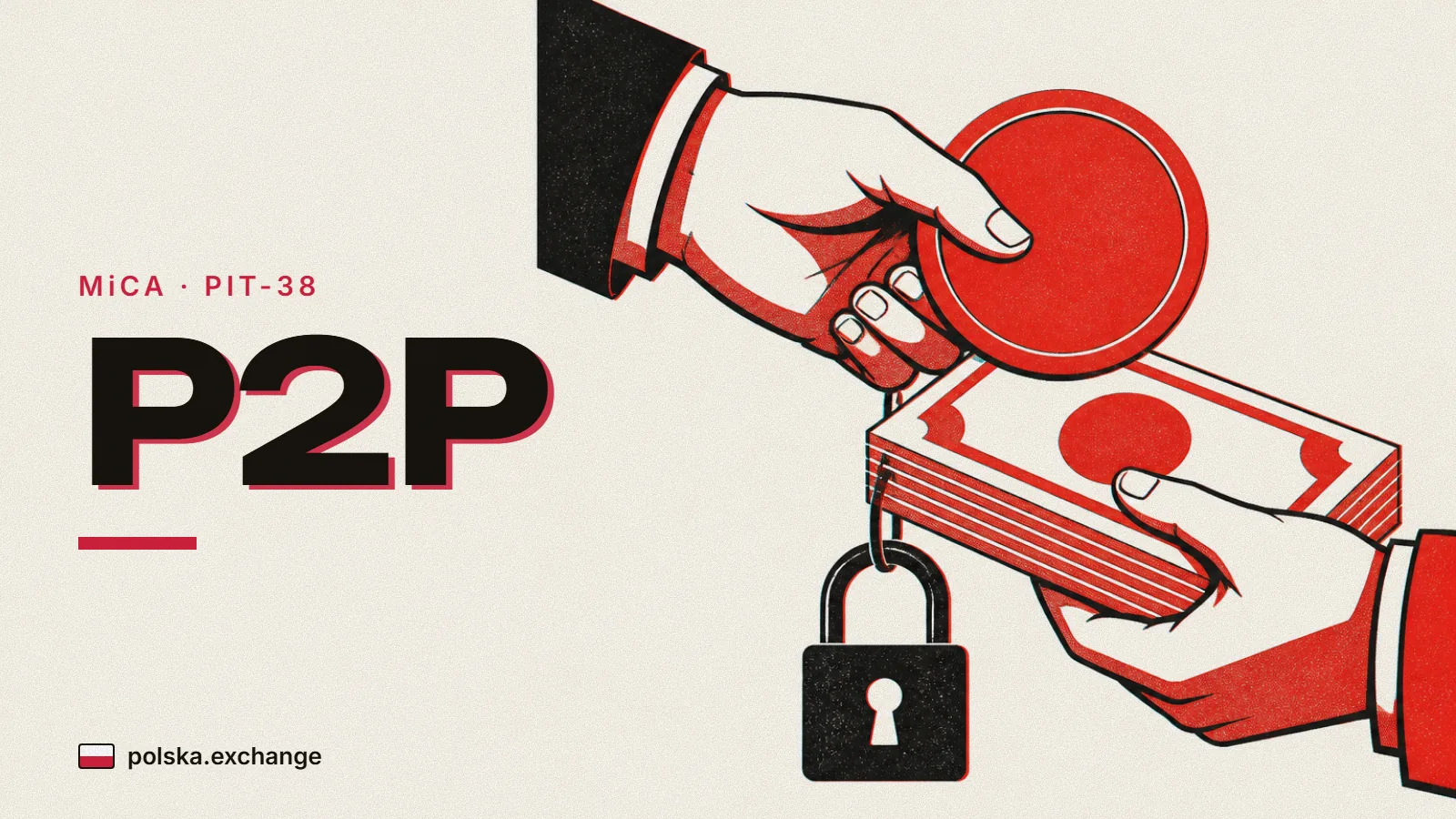
MiCA prohibits providing crypto-asset services without authorisation, but that ban is aimed at those who provide the services, not at people who own crypto. Someone who now and then sells their own crypto to another person apparently does not fall within the definition of a crypto-asset service provider: that is our reading of the Regulation. A P2P platform is different: it matches buyers' and sellers' orders, and in our reading that is a crypto-asset service that needs authorisation. After 1 July 2026, only companies with a valid MiCA authorisation may provide crypto-asset services in Poland, and there is no Binance company in the ESMA register.
What P2P means in crypto
P2P (peer-to-peer) is a trade in which you buy crypto from another person rather than from an exchange. On a P2P platform, the seller posts an offer, the buyer sends them money, and the platform holds the crypto until the trade is closed. Under MiCA, running a trading platform, holding clients' crypto and exchanging crypto for money are all crypto-asset services.
Do not confuse P2P platforms with a BLIK transfer to a phone number. That is a bank-to-bank transfer that requires no account number, is free and works around the clock, though the recipient must be registered with BLIK. On P2P platforms, BLIK is only a payment method.
Who may sell crypto on P2P
The MiCA Regulation prohibits providing crypto-asset services in the EU without authorisation. Under MiCA, a crypto-asset service provider is a firm that provides crypto-asset services to clients on a professional basis, as its occupation or business. MiCA is explained in the guide What is MiCA.
There is no dedicated rule or ESMA guidance on P2P, so what follows is our reading of the Regulation.
- Someone who now and then sells their own crypto to another person apparently does not fall within the definition of a crypto-asset service provider.
- Someone who buys and sells crypto with clients on their own account as a business is, in our reading, providing the crypto-asset service of exchanging crypto for funds.
- A platform that matches the orders of many buyers and sellers within its own system is, in our reading, covered by the definition of a trading platform.
Only a legal person or other undertaking can obtain a CASP authorisation. So trading regularly on P2P as a business, for example on exchange-rate differences, may in our reading amount to a crypto-asset service for which a private individual cannot get authorisation; the Regulation does not say where 'now and then' ends. If a regular P2P seller claims to hold a MiCA authorisation, look up their company in the ESMA register.
Binance P2P and other platforms after 1 July 2026
After 1 July 2026, only companies with a valid MiCA authorisation may provide crypto-asset services in Poland, according to the Tax Administration Chamber in Katowice. As of 18 October 2026, there is no Binance entity in the ESMA register, and no Polish company holds an authorisation either. Poland is among the listed countries of, for example, Kraken, Coinbase, Revolut, Bybit EU, OKX Europe, Bitstamp and SIA AlphaRoute (Kanga Exchange). These are MiCA-authorised companies, not necessarily P2P platforms: we have not checked whether they offer P2P.
On 24 June 2026, Binance announced that it had withdrawn its MiCA application in Greece and would seek authorisation in another EU country. In the same post, Binance writes that some users may be affected depending on their country and account status, and that it will contact them directly. To see what your own account can do, check Binance's emails and in-app notifications. Binance warns that it never contacts users by phone and never asks for passwords, 2FA codes or private keys. We have not found an official Binance page on P2P terms specifically for Poland.
According to ESMA's statement, clients of unauthorised providers do not get MiCA protection, including protection of their assets. ESMA invites clients to check their provider in the register and, if it is not authorised, to act promptly, including by moving their crypto to an authorised provider, where one is identified, or to their own wallet. According to the Tax Chamber in Katowice, firms without a MiCA authorisation should be treated as high-risk, and crypto held with crypto-asset service providers is not covered by any state guarantee.
If you buy USDT on P2P, the rules for that token apply as well: they are covered in the guide Is USDT banned in Europe and Poland?.
P2P scams in Poland
A P2P seller can be paid with someone else's money. KNF explains that in fake investment schemes, fraudsters may move a victim's money to the account of another victim, a "money mule" (a front account holder), or a crypto exchange. A crypto seller who receives such money can end up as a link in that chain.
On 23 February 2026, PKO BP warned about a similar scheme with a BLIK transfer sent "by mistake". A BLIK phone transfer arrives from an unknown number, and then a caller asks you to send the money back to a different phone number or account. The bank warns that this way you can unknowingly become part of a fraud: money sent by mistake goes back only to the account it came from.
How to protect yourself on P2P:
- accept payment only from an account where the account holder's name matches the buyer's name on the platform;
- do not release the crypto until the money has arrived in your account, and check this in your banking app rather than relying on a screenshot;
- if the money comes from someone other than the buyer, do not release the crypto, and send the money back only to the account number it came from, not to an account or number you are given;
- a matching name does not protect you from the money-mule scheme: the money may come from the account of another victim or a front account holder;
- do not transfer money to third-party accounts or phone numbers "as a favour";
- keep the chat records, trade history and payment confirmations: your bank may ask where the money came from.
Other signs of fraud when exchanging crypto are covered in the guide How to avoid scams when exchanging crypto.
Tax on selling crypto via P2P
Selling crypto for money, including on the open market, is a disposal for consideration that you must declare, while swapping one crypto for another is not taxed. Tax is charged on income at a rate of 19%. Selling crypto never produces a tax loss: if your costs exceed your revenue, your income is zero and the excess costs carry forward to the following year.
You report this on a PIT-38 return, filed between 15 February and 30 April of the following year. You report costs for the year in which you incurred them, even if you sold nothing that year.
Frequently asked questions
Is it legal to sell crypto via P2P in Poland?
Does Binance P2P work in Poland?
What is BLIK P2P?
Someone I don't know sent me money and wants me to pass it on. What should I do?
Do I pay tax on selling crypto via P2P?
Data as of 18 October 2026. This is general information, not legal or tax advice.
How to avoid scams when exchanging crypto
Where to exchange crypto safely, how to check an exchange office in the ESMA and KNF registers, and what to watch for at the counter.
How much crypto can you exchange in Poland without ID (KYC)?
Under Polish law, the threshold is EUR 1000 per one-off exchange. When you will be asked for ID regardless of the amount, and what changes on 10 July 2027.
What is MiCA: the EU crypto regulation and what it changed in Poland
The EU crypto regulation explained: Poland before MiCA, what changed on 1 July 2026, why there are no Polish authorisations, how to check a provider.