
Is USDT banned in Europe and Poland? What the ESMA and MiCA documents say
What MiCA prohibits and what it does not, what ESMA's document of 8 October 2026 expects from authorised firms, and what USDT holders in Poland should check.
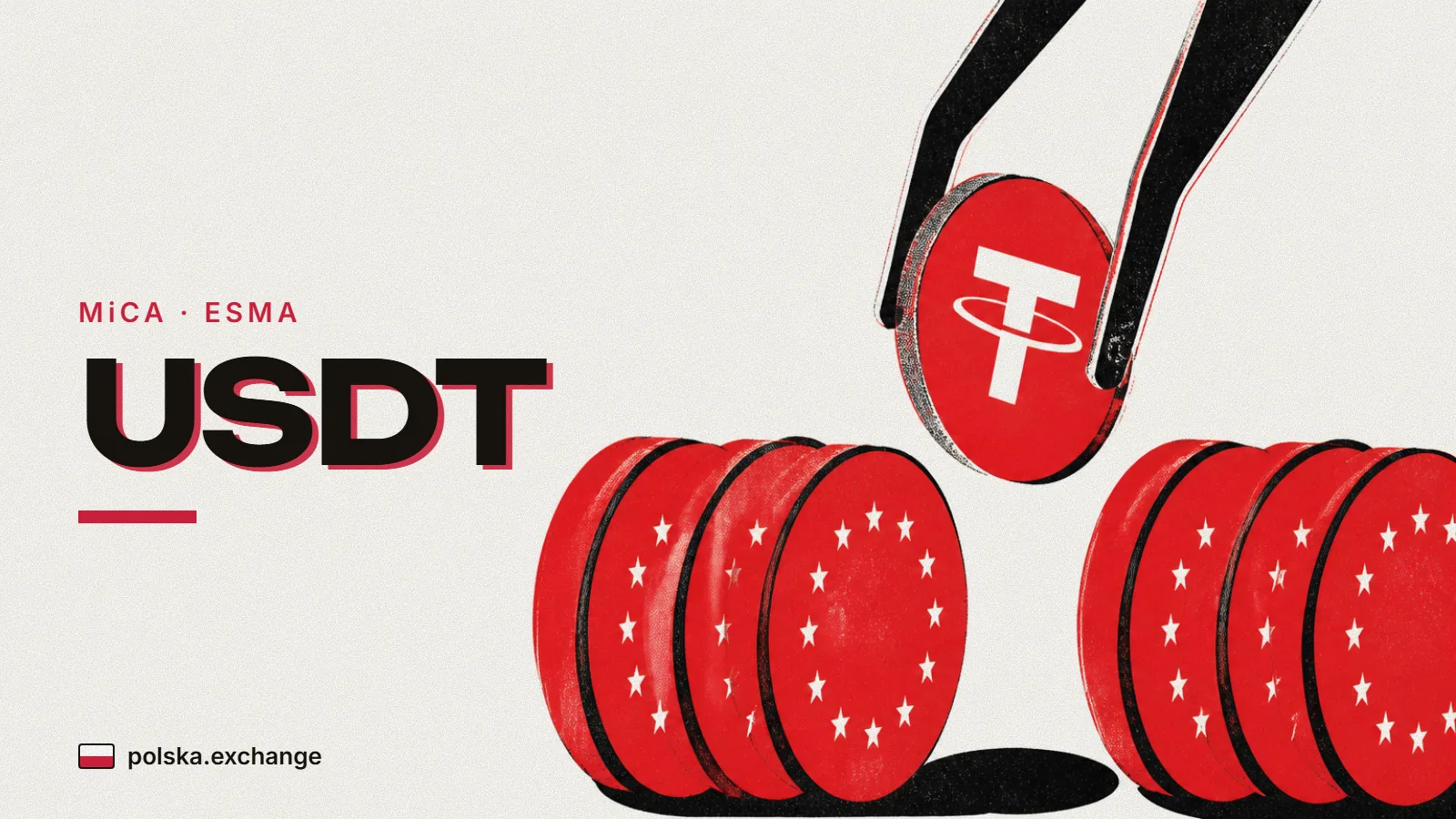
Holding USDT is not prohibited by the MiCA Regulation, whether you live in Poland or in another EU country. The regulation targets service providers: offering crypto-asset services without authorisation is prohibited, while Article 59 does not forbid anyone to own crypto. Tether holds no authorisation anywhere in the Union, and its name does not appear in the ESMA register. Retail customers in the EU cannot buy USDT on the large MiCA-authorised exchanges, since none of them sells it. An ESMA document of 8 October 2026 states that authorised firms should not provide any services involving such stablecoins, and that includes holding and transferring them.
Why USDT came under restrictions
Tether issues USDT, a stablecoin pegged 1:1 to the US dollar. Under the MiCA Regulation, an e-money token is a crypto-asset that aims to keep its value stable by reference to the value of one official currency. The token matches that description, though no ESMA document has been found that expressly classes USDT as an e-money token. For an overview of the regulation and its role in Poland, see the guide What is MiCA.
An e-money token can be offered to the public in the EU only by its issuer, and only when that issuer holds authorisation as a bank or an electronic money institution, has put out a white paper and has notified the regulator. Any other firm may make such an offer only with the issuer's written consent. As of 17 October 2026, Tether does not appear in the ESMA register. Under MiCA, then, USDT counts as a stablecoin with no EU authorisation.
The position of ESMA and the European Commission
In an answer on stablecoins dated 17 January 2025, the European Commission explained that offering such tokens to the public, or seeking their admission to trading, is allowed only if the issuer holds MiCA authorisation. When an exchange lists a token whose issuer is not authorised, this counts as seeking the token's admission to trading. Exchange, order transmission and order execution can also amount to an offer to the public if the firm promotes or advertises the token within the service.
ESMA's statement of 17 January expected firms to stop selling such stablecoins to their clients by the end of January, with a sell-only mode allowed until the end of the first quarter of 2025. Back then, ESMA still expected that plain custody and transfers should stay possible.
What changed on 8 October
On 8 October 2026, ESMA issued an Opinion on crypto-asset services connected with stablecoins that are not MiCA-compliant. According to this document, authorised firms should not provide any service that involves such tokens. It covers the following services:
- operating a trading platform and providing exchange services;
- receiving, transmitting and executing orders;
- placing crypto-assets and giving advice;
- custody and transfer services;
- managing portfolios.
ESMA expects firms to install controls that make such tokens unavailable in the EU, so that clients cannot buy them or enlarge their positions. The Opinion is addressed mainly to national supervisors and leaves the European Commission's earlier position unchanged. It is guidance for supervisors, while the rules for the stablecoins themselves are set by the MiCA Regulation, Article 48 among them.
Where a supervisor discovers that a firm still keeps client balances in such tokens, it should have them removed as soon as possible, and within three months of publication at the latest. Counting three months from 8 October gives 8 January 2027; ESMA does not state this date itself. Until that point, a supervisor may allow only the steps needed to close out a position: sale, conversion, withdrawal, transfer or safekeeping of balances already held, and no new purchases or trading.
What exchanges are doing with USDT
As of 17 October, the MiCA-authorised exchanges describe their approach on their own websites as follows.
- Coinbase: retail customers in the EEA face restrictions on buying, selling and converting USDT, and can only withdraw it to an external wallet, where supported, by 30 October 2026. Any balance left will be converted into USDC at the market rate, and USDT sent after 30 October will not be credited.
- Kraken: USDT has been delisted for EEA clients, Poland included. You can only deposit or withdraw it, and Kraken does not recommend deposits, since EEA residents can no longer trade the token on the platform.
- OKX Europe: EEA residents are unable to trade USDT, and any amount deposited can only be converted into USDC, with no way to convert back.
- Revolut: USDT has been taken off the platform, incoming transfers of it are rejected, and after checks the funds are returned to the customer's address.
- Bybit EU: none of the spot trading pairs on its official EEA list includes USDT, while USDC is paired with the złoty.
- Bitstamp: Bitstamp Europe S.A. switched off USDT trading for its customers in January 2025 and announced an automatic conversion of balances into USDC on 6 May 2025.
No Binance entity appears in the ESMA register, which means Binance holds no MiCA authorisation. After 1 July 2026, crypto-asset services in Poland may be provided only by firms with MiCA authorisation. MiCA safeguards, asset protection among them, do not extend to clients of unauthorised providers, and the Tax Administration Chamber in Katowice states that such providers should be regarded as high-risk. The same notice adds that their activities may mean a higher risk of clients losing access to their assets, and that state guarantees do not cover crypto kept in accounts with crypto-asset service providers. Platforms revise their terms, so look at your exchange's current page before you send anything.
Can you keep USDT in your own wallet
Yes. MiCA's ban on crypto-asset services without authorisation applies to those who provide them, not to anyone who owns crypto. MiCA does not cover the makers of non-custodial wallets, whether hardware or software, where the keys stay with you. The ESMA document of 8 October deals with custody at authorised firms, not with a wallet of your own.
The picture changes for USDT kept on a MiCA-authorised exchange. Under the ESMA document, supervisors should require these firms to remove client balances; until that happens, a supervisor may allow them to offer only sale, conversion, withdrawal, transfer or safekeeping of the balances. If your tokens sit on such an exchange, check its deadlines, because otherwise it may convert the balance for you without asking, as Coinbase will. Large exchanges holding MiCA authorisation seldom accept withdrawn USDT back: Revolut rejects such transfers, Coinbase will not credit them after 30 October, Kraken advises against deposits, and OKX Europe takes USDT only for conversion into USDC.
USDT in Poland: exchange offices and cash
The Tax Administration Chamber in Katowice states that after 1 July only firms holding a valid MiCA authorisation may provide crypto-asset services in Poland. No Polish firm appears in the ESMA register as MiCA-authorised. What the register does show are authorised firms from other countries that include Poland in their list of countries, such as Kraken, Coinbase, Revolut, Bybit EU, OKX Europe, Bitstamp and SIA AlphaRoute (Kanga Exchange).
An exchange office trading USDT for cash on its own account is providing a crypto-asset service, the exchange of crypto for funds, because MiCA treats cash as funds too. For such an office, two issues arise together: whether the firm behind it holds MiCA authorisation, and how it deals with USDT if authorised firms, under the ESMA document, should not provide services involving the token. If an exchange office presents itself as MiCA-authorised, search for it in the ESMA register under the company's registered name. The guide How to avoid scams when exchanging crypto explains the warning signs of fraud.
In the directory, offices show their coins, opening hours and the date their details were last checked, and offices that have stopped exchanging are marked.
What to use instead of USDT
In the ESMA register's file of e-money tokens, Circle Internet Financial Europe SAS, a French electronic money institution, appears with two stablecoins: USDC, tied to the dollar, and EURC, tied to the euro. Coinbase will move any USDT its retail EEA clients still hold into USDC, and on OKX Europe deposited USDT can be converted only into USDC. Bybit EU offers a USDC pair with the złoty. Because the ESMA register is refreshed every week, check a token there before buying it.
What USDT holders should do now
- Find out whether your USDT sits on an exchange or in a wallet of your own.
- If it is on an exchange, look for the exchange's stablecoin page and the deadlines set for your country.
- Choose what to do with the balance before your exchange's deadline, and check which options it offers: Coinbase and Kraken only permit withdrawals of the token, while OKX Europe accepts it only for conversion into USDC.
- The deadline at your exchange may fall before 8 January, when the three months after the ESMA document end (ESMA does not state this date itself): at Coinbase it is 30 October.
- Do not move the token to a place that no longer accepts it, such as Revolut or, after 30 October, Coinbase.
- If your exchange does not appear in the ESMA register, ESMA invites you to act promptly, including by moving your crypto into a wallet of your own or to an authorised firm, if one has been identified.
- Check the network and the wallet address twice before any withdrawal.
Frequently asked questions
Is USDT banned in Europe?
Why was USDT removed from European exchanges?
Can I keep USDT on Ledger, Trust Wallet or MetaMask?
What happens to USDT held on an exchange?
Can I buy USDT in Poland?
USDC or USDT?
Information current as of 17 October 2026. What you read here is general information, not legal advice.
How to avoid scams when exchanging crypto
Where to exchange crypto safely, how to check an exchange office in the ESMA and KNF registers, and what to watch for at the counter.
How much crypto can you exchange in Poland without ID (KYC)?
Under Polish law, the threshold is EUR 1000 per one-off exchange. When you will be asked for ID regardless of the amount, and what changes on 10 July 2027.
What is MiCA: the EU crypto regulation and what it changed in Poland
The EU crypto regulation explained: Poland before MiCA, what changed on 1 July 2026, why there are no Polish authorisations, how to check a provider.